Eternal Elegy (work still in progress) is a generative composition building on some of the concepts explored in Music for Empty Spaces. Goals for this piece were to maintain the independence of the individual voices (up to six + one additional pitched delay line) and for the controllers to generate a more organic counterpoint than in previous compositions. The music is heavily influenced by traditional counterpoint and voice leading principles of the Renaissance. Learning about creative uses of shift registers was a major catalyst for the new approach to generative music found here. With this has also come a deeper understanding of the sample and hold module and all its uses. The exact nature of form and length of one “variation” is still undetermined.
For one, using shift registers saves on processing power (always in short demand) but, more importantly, it offered this composer a realistic opportunity to create an interval based voice generation and all the benefits therein (balancing leaps and steps, directional control, imitation, and much more).
Anyone interested in the Zoia and shift registers should check out the following video by Christopher Jacques (who is my go to source of knowledge and inspiration):
Below are modular grid diagrams of each Zoia. This piece is still in progress and the grids will likely continue to evolve. Due to the many modules required for all of the calculations I am using five units and their combined processing power. In future updates to this web page I hope to provide a more detailed image of all of the grids. Not currently visible are connections between devices (of which there are many).
Modular Grids
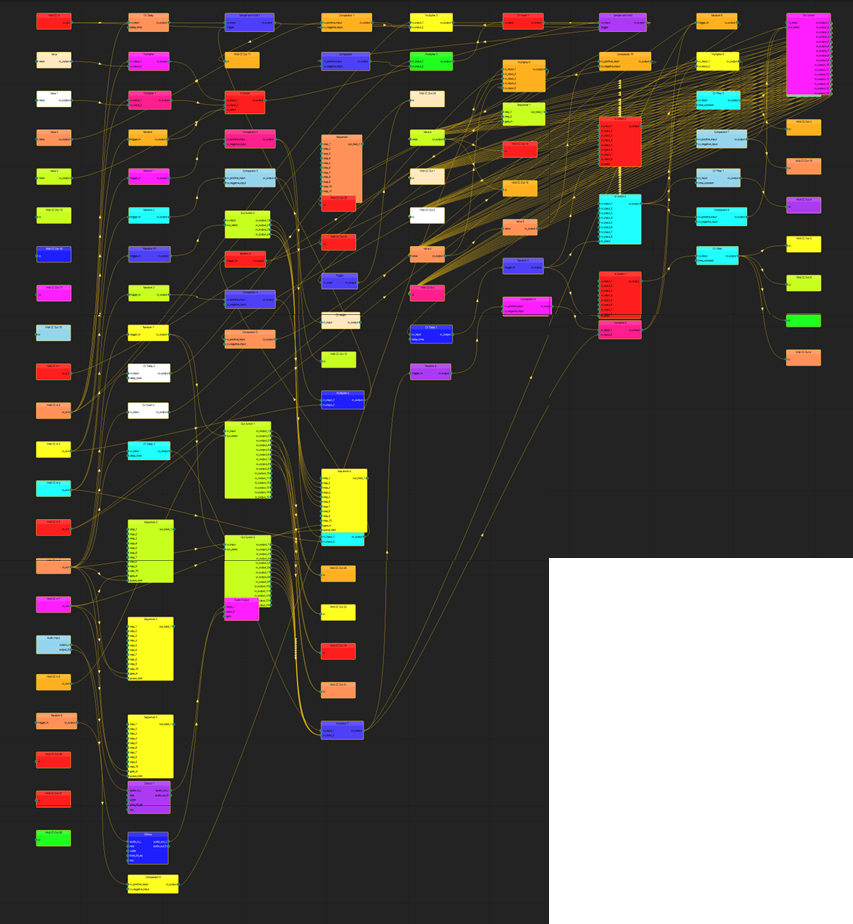

Zoia 2 Modular Grid

Zoia 3 Modular Grid

Zoia 4 Modular Grid
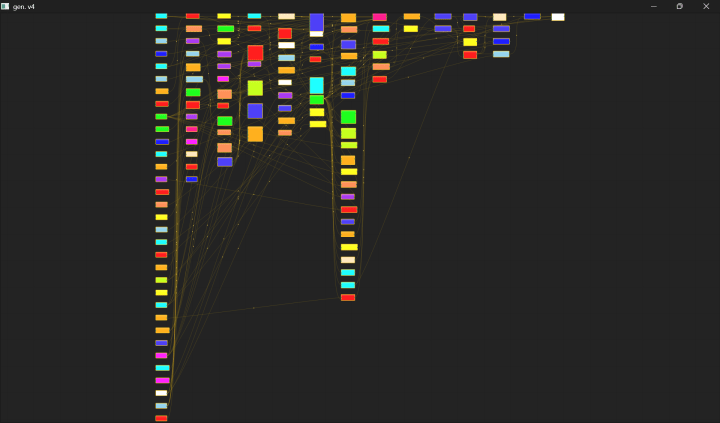
Zoia 5 Modular Grid
Instruments & Effects
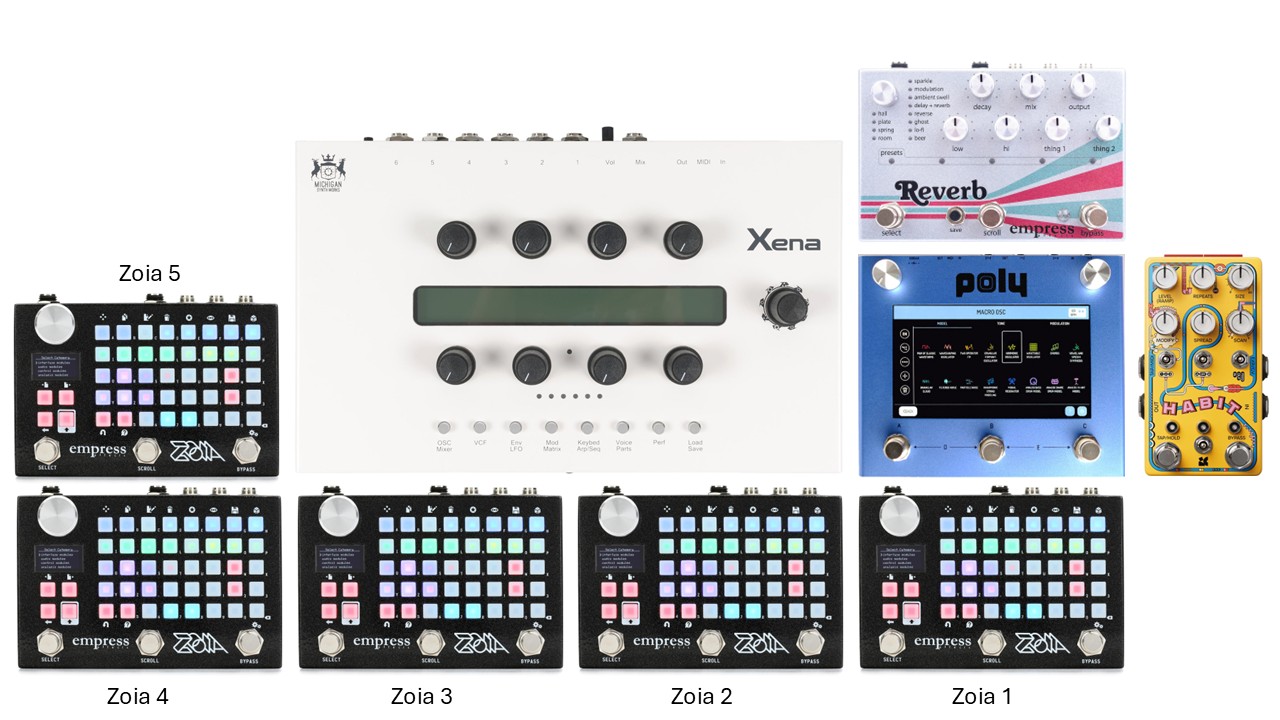
Each Empress Effects Zoia (x5) is the brains and control surface for the individual voice. All midi flows downstream from Zoia 2 with the exception of a loop back to Zoia 1.
All generative algorithms were built using Zoia’s modular eco system. Some of the interval based voice leading principles integrated into the algorithm include directional probability, size, range, sequencing, imitation, and more. The use of shift registers throughout is crucial in achieving the desired results (new to this generative composition).
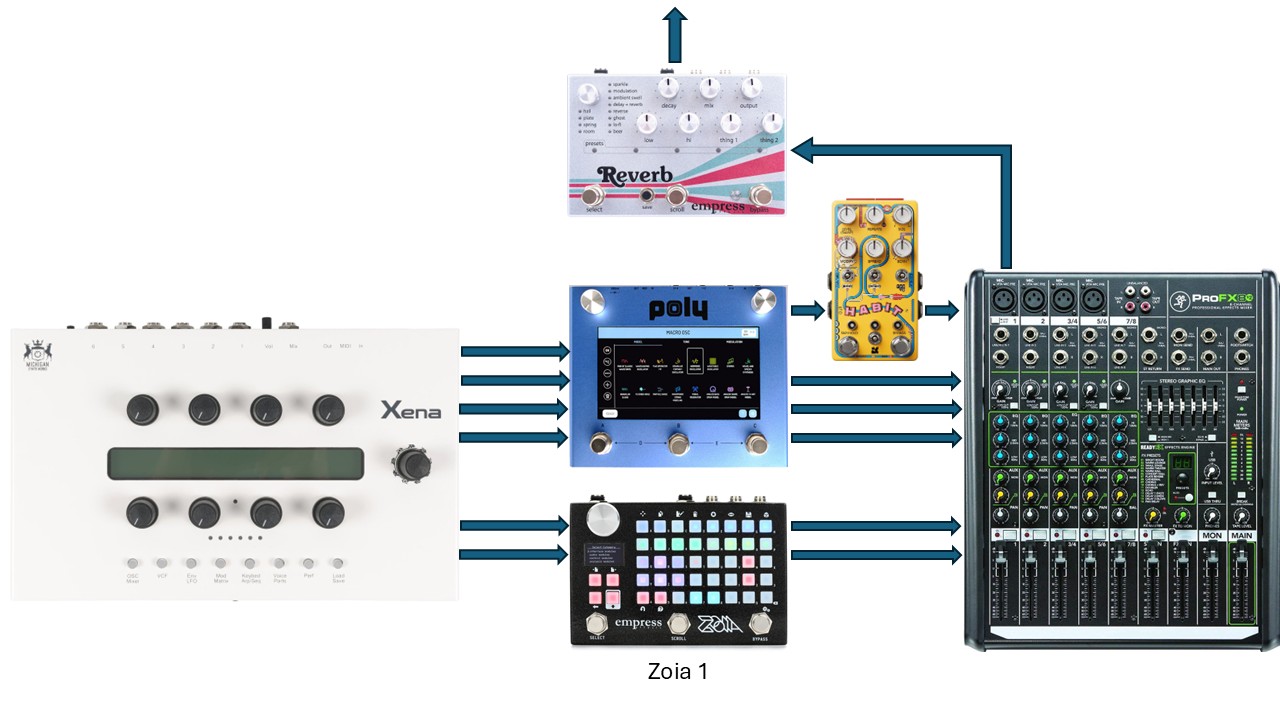
Chase Bliss Habit adds an occasional delayed echo of voice 1 a perfect 4th below. The probability of this delay being triggered is not only dependent on which voices are active, but also the relative pitch of voice 1.
Michigan Synth Works Xena is a versatile synthesizer that allows for a configuration of six individual mono synths (each with its own 1/4″ output). The oscillators are digital, but the filters are analog (one per voice). In the case of the instrument used here the filters are modern reissues of the original Roland filter chips.
Excluding the bass voice, each of the other five mono synths consists of two oscillators detuned by 12 cents. One is a basic waveform, the other a more complex one.
The bass voice has two complex oscillators tuned an octave apart with a sub an octave below.
All voices have narrow and slowly modulated filter and pitch fluctuations using the Xena’s mod matrix with internal LFOs and Envelopes.
The tuning for the five upper voices is set to just intonation, the tuning for the bass is equal temperament.
Poly Effects Beebo adds chorus to voices 1, 2, 3, and 5. Chorus for voices 4 and 6 are provided by Zoia 1.
Empress Effects Reverb is set to a modulated reverb that adds an additional chorus to all voices.
Connections

 Daniel C Pappas