Music for Empty Spaces is a fully generative composition and the follow-up to Generative Waves (a semi-generative piece requiring some human performance intervention). Here are several of any infinite number of variations to be generated. They were each recorded in one take and have been commercially released unedited.
Empty Spaces
In towns both large and small there are many now vacant spaces were faint echoes of a once thriving past reverberate. Whether it be the remnants of an industrial complex, an abandoned mansion, a school building no longer in use, or an overgrown lot, these spaces speak to the passage of time in profound ways.
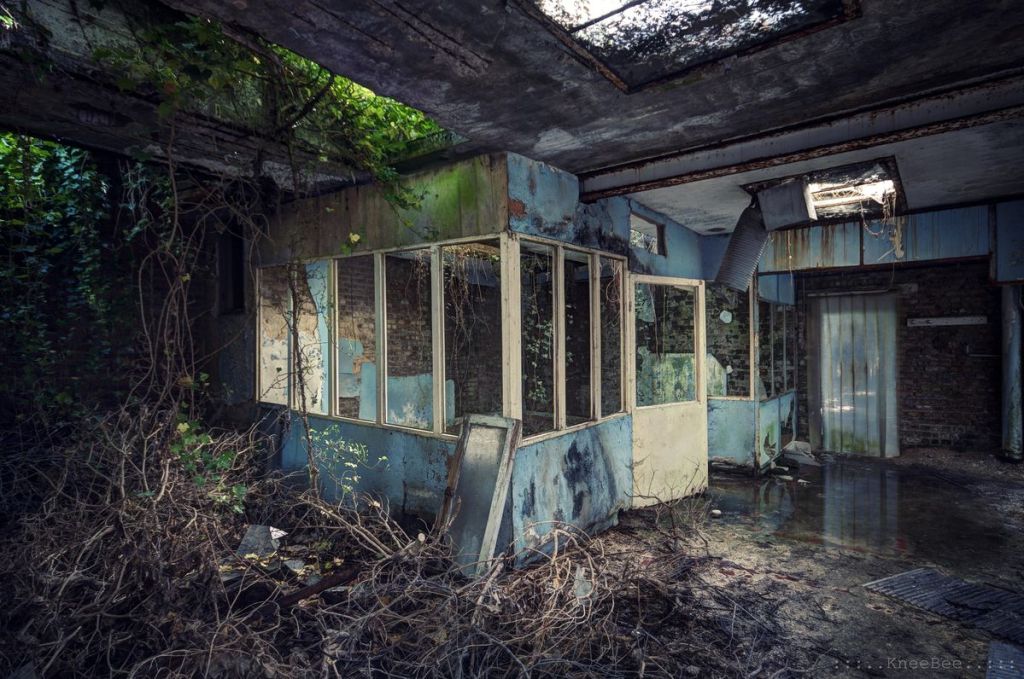
For example, in the city of Burlington, IA , where I work, one can see history on every corner. The past looms large in the many historic buildings downtown. Some have been restored, but many are in various stages of decay. A once thriving river town, Burlington is now at an intersection.

Listening to Music for Empty Spaces may conjure up an image of entering into the now empty work floor of a large factory building. It is quiet, the large windows are broken, you can see the sky above, the roof is missing in sections. Nature has regained the upper hand and punctuated the gray concrete floor with color. When you close your eyes you imagine a beehive of activity, the clanking and scraping of metal, the loud machinery, human voices, progress. When you open your eyes you hear nature’s present sounds, those that existed long before and remain long after.
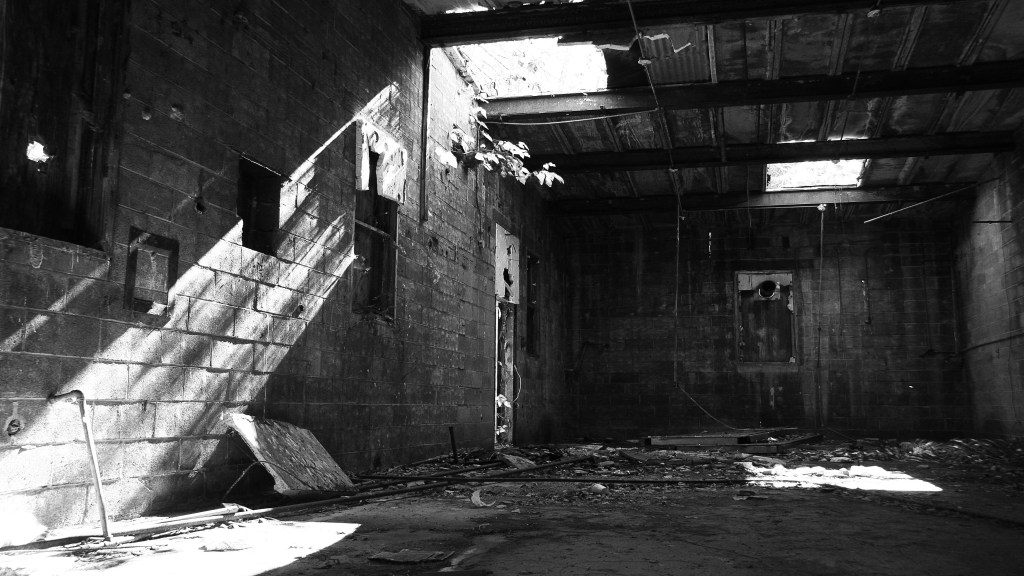
Some of the thoughts that have occupied me during the writing of this music concern the idea of permanence; what remains?
There is of course physical matter and its decay. There is also memory and a life lead therein. Much time and effort is spent on preserving and valuing the past, while also looking to and hoping for a more prosperous future. What then makes up the present?
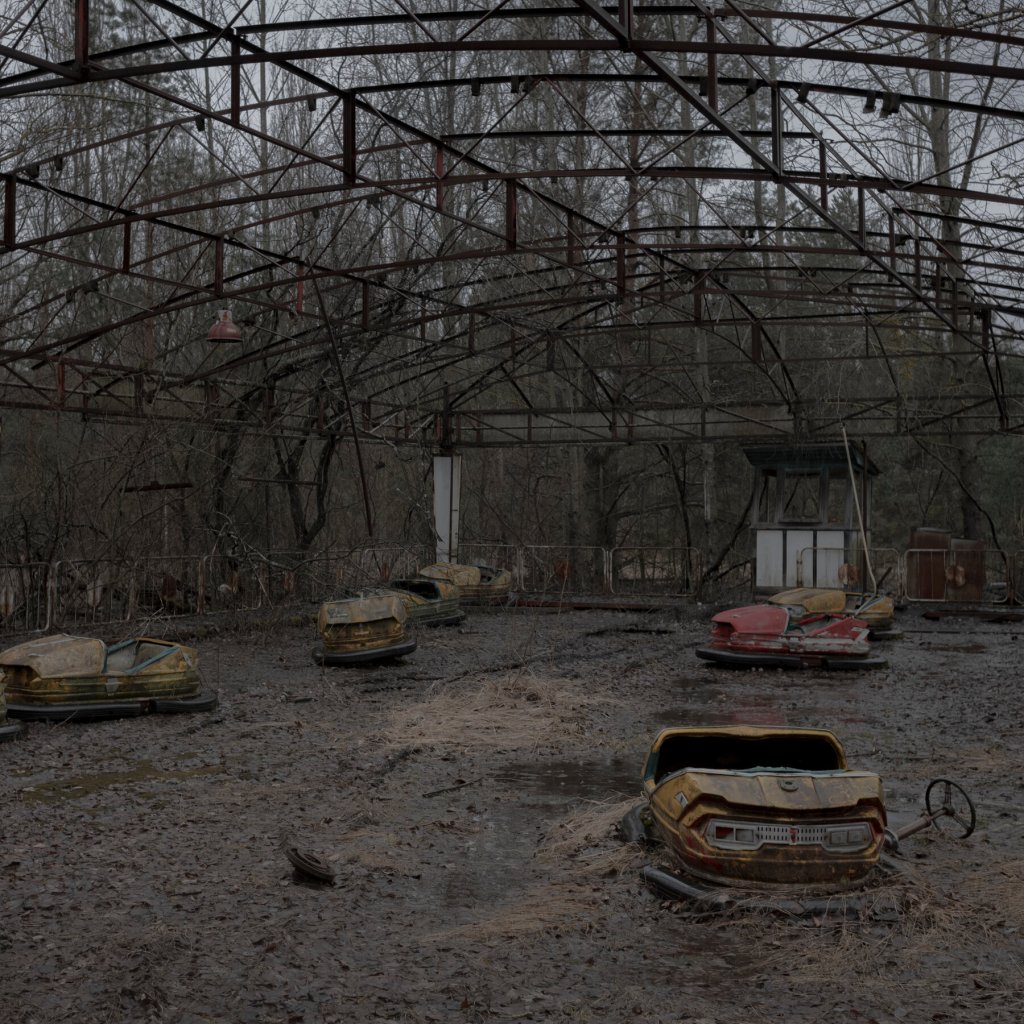
The temporal nature of music has always been fascinating to this composer. When does music become music? Only in the moment it is heard? Now that we have recording capabilities, what does this mean for preservation? Does physical matter lend permanence? What about generative music which, by its nature, is ever changing, never to be repeated? What value is there in 20 minutes of music that are gone forever the moment they have sounded?
Finally this music also touches on themes such as loneliness, regret, and the notion that the best of life lies in the past.
The Project
My interest in Generative Music making started a few years ago but my music has been moving in this direction since 2006, gradually giving the performer more freedom to interpret and even improvise withing a framework.
Generative Waves, a piece I recorded in late 2022, is an interactive piece for myself the performer and my generative music machine. My role in live performance was to shape and control some of the decision making as well as introduce elements based on my musical intuition (and decisions being made by the Generative A.I.). You can listen and learn more about it here:
In a way, my interest in jazz informed my desire to work with generative instruments (of my making). One minute of recorded jazz is born in the minute it takes to perform it, whereas in more traditional composition, one minute of music can take three months to create. For this music, I wanted to tap into that way of composing.
Furthermore, my goal became to remove the live (human) performer entirely from the equation and allow all decisions to be made by the A.I. algorithms. This of course posed some challenges.
Not only should the machine I create make compositional and performance decisions that I would make, but they must be cohesive and relevant to only this piece of music.
The task essentially was to teach the A.I. how I compose (and all my musical background that informs it), but also the intentions behind the specific music and purpose for which it was created. All this needed to happen within some very real limitations to the processing power available to me.
The brains of Music for Empty Spaces (the title for this project) is in the simplest form a vast interconnected neural network (or decision tree) with many probability gates.
Every time the piece is performed (turned on and off again) it yields different results. Nevertheless, they should all communicate the intent of Music for Empty Spaces using the musical language of Daniel Pappas, if I am to be successful.
On the most basic level, the piece was conceived as a work for five independent voices (parts). The upper four voices form a pseudo synthesized string ensemble with the fifth, the bass, being more of a classic analog mono synth sound.
The intended length of each ‘take’ is right around twenty minutes with an arc that gradually ‘rises’ to approx. the twelve minute mark and then ‘falls’ over the course of the final eight minutes. The rise and fall is mainly a rise and fall in probability for various events/controls.
Before diving more deeply into the intricacies of the music a brief note on the technical side of how the music is ‘generated’.
The Technical Side

Poly Effects Beebo (Synths 1-4)
The upper four ‘string’ voices are generated within Beebo using the Macro OSC module (0ne per voice). The module is a “powerful multimodal oscillator voice based on Mutable Instruments Plaits module.” The specific synthesis model is modulated/inharmonic string synthesis with controls over the amount of inharmonicity, or material selection, excitation brightness and dust density, and decay time (energy absorption).
Gradual changes to the above parameters is audible throughout with changes being controlled via midi and probability gates from Zoia 2.
Dreadbox Nymphes (Bass Synth)
The bass voice is generated by the Nymphes, a six voice, all-analog, polyphonic synthesizer. The mode set for this piece is UNI A with all six oscillators playing in unison. Added to these voices is an additional sub oscillator set at 3/4 volume. The built in LFOs and envelopes control the slow filter sweeps as well as slight movements to the pitch of the sawtooth wave. Oscillators are also detuned by a few cents to add character.
Empress Effects Zoia (The Brains)
Two of the four voices that pass through the Zoia pedals are additionally fed through ring modulators followed by delays (within Zoias ecosystem). The delay time for each delay varies throughout with the help of a clocked random module. Occasionally a change in delay time coincides with an active ring modulator resulting in audible echoes of this shift.
Chase Bliss Habit (Echoes of the Past)
Habit is a delay with a memory. In earlier iterations of the public releases Habit was set to Wipe: Muting the echo, leaving only the memory active. This produced occasional, short, random echoes from the past. At the onset the echoes don’t reach too far into the 3 minute buffer and happen quite infrequently. As the arc of the piece rises and falls, the frequency of the echoes increases and decreases and reach further into the past (buffer). “Violin 1” feeds into Habit. For the final version of the music there is an additional Chorus effect with randomly changing, varied states of simulated tape decay to one of the voices. When the tape decay reaches an extreme setting the pitch is audibly effected.
Chase Bliss Mood Mkii (Panning Fragments, Sounds of Activity)
“Violin 2” feeds into Mood.
Montreal Assembly Count to Five (Shimmering Pitched Delays in Fourths)
“Viola” feeds into Count to Five. Count to five adds a short pitched delay that changes intervals smoothly throughout.
All parts go to a mixer where they are panned and then the stereo image is fed to the Empress Reverb (stereo i/o).
The manual describes Gen Loss as “a VCR deconstructed. It takes each of the oddities and artifacts tape machines impart on your sound and gives them an independent control.”
In line with the idea of decay and permanence Gen Loss introduces certain artifacts post reverb such as:
Wow: Sets the depth of slow, smooth, random pitch modulation. Your classic tape-style motion, like unpredictable vibrato.
Flutter: Sets the intensity of fast, twitchy, random modulation. Affects both amplitude and pitch, giving the impression of quivering, trembling tape.
Failure: Gradually introduces a number of small malfunctions that naturally occur in tape machines and give them that living feel: snags, drops, crinkles, and pops.
All are used in very subtle ways with drops, crinkles, and pops (failure) omitted.

Each of the four outputs from Beebo represent one of the four synth voices generated by the four Macro Osc synth modules. A pair of voices each goes into the L/R inputs of two of the three Zoias. Three out of four voices are additionally routed through additional effects (one per) and then are all routed to the mixer where they are panned and sent out in stereo to the Empress Effects Reverb. From the Empress Effects Reverb the signal flows to the Chase Bliss Gen Loss for some post reverb character (introduction of slight imperfections).
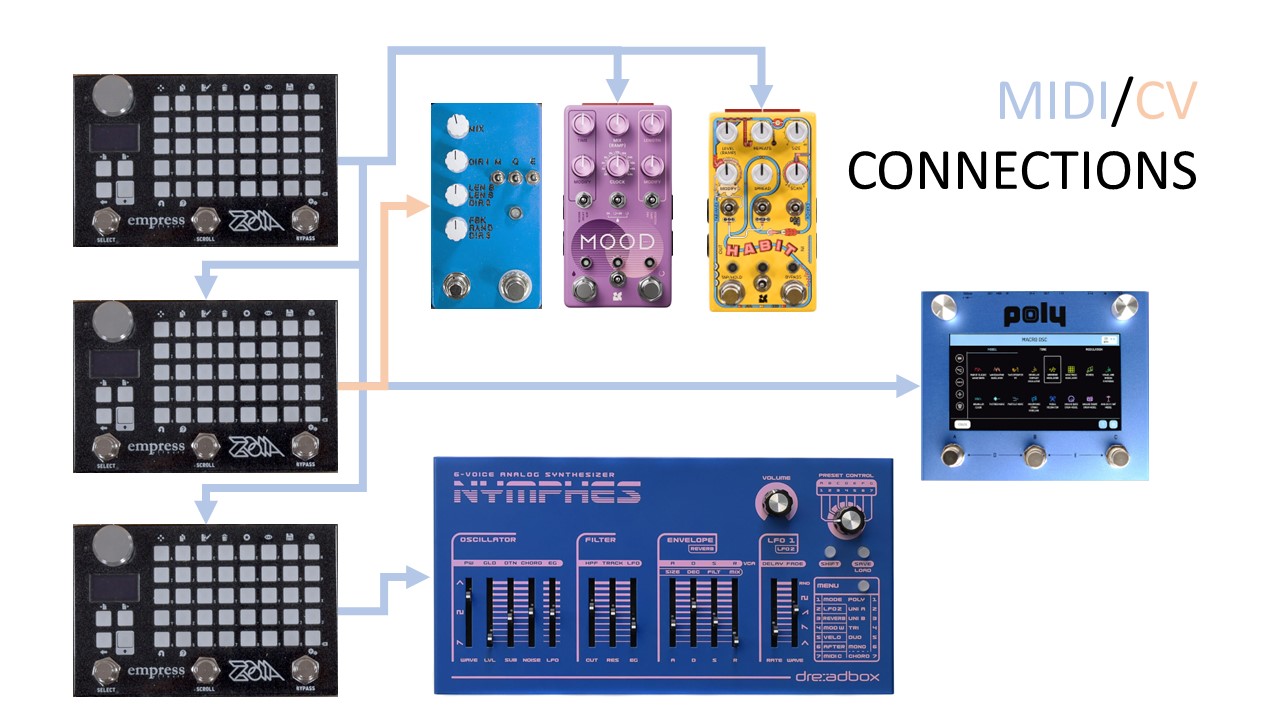
Zoia 1 functions as the master clock and sends control messages to many of the other pedals coordinating events. Zoia 2 receives messages from Zoia 1 and relays messages to Beebo. Zoia 2 also controls some of the functions of Count to Five via CV. Zoia 3 receives messages from Zoia 1 and relays messages to the Dreadbox Nymphes.
The Music
Music for Empty Spaces is made up of a collection of musical phrases. These phrases vary in length and may include moments of rest at their conclusion (or not). Various sequencers are employed to switch between phrase lengths (these are not pitch sequences, but time sequences).
As the arc referenced above rises, so does the probability of phrase options (initially limited to only a few shorter phrases). Additionally, the probability of some voices (either individually or in pairs) holding across the ‘rests’ increases/decreases in connection with the arc’s rise and fall.
The entrances of the five voices are controlled first by the phrase sequence currently selected. Each individual voice can however enter and exit within that phrase independently from one another. At times the parts will have very coordinated entrances, and at other times they will seem rather independent from one another. This again is due to the individual probability gates for each voice.
Pitch and change of pitch is controlled independently for each voice using various probability gates. A general range for each part is set to roughly coincide with those of a string ensemble (violin 1&2, viola, cello, bass). The range of each part individually can be widened and made more narrow throughout, again at random.
For this piece the pitch of each voice (excluding the bass) is quantized to either C major, A Harmonic Minor, or C Whole tone (each having a particular probability assigned). The bass stays diatonically in C. Following the arc of the piece, the upper voice is increasingly doubled at the octave (and then of course the chances of this begin to decrease again).
Microtonality is introduced as some of the voices slowly modulate their pitch ever so slightly up and down (sine wave LFO). Since the modulation occurs at different rates, the voices appear to continuously move in and out of tune with each other. The distance of the pitch shift is minimal at first and increases/decreases with the arc of the piece.
 Daniel C Pappas